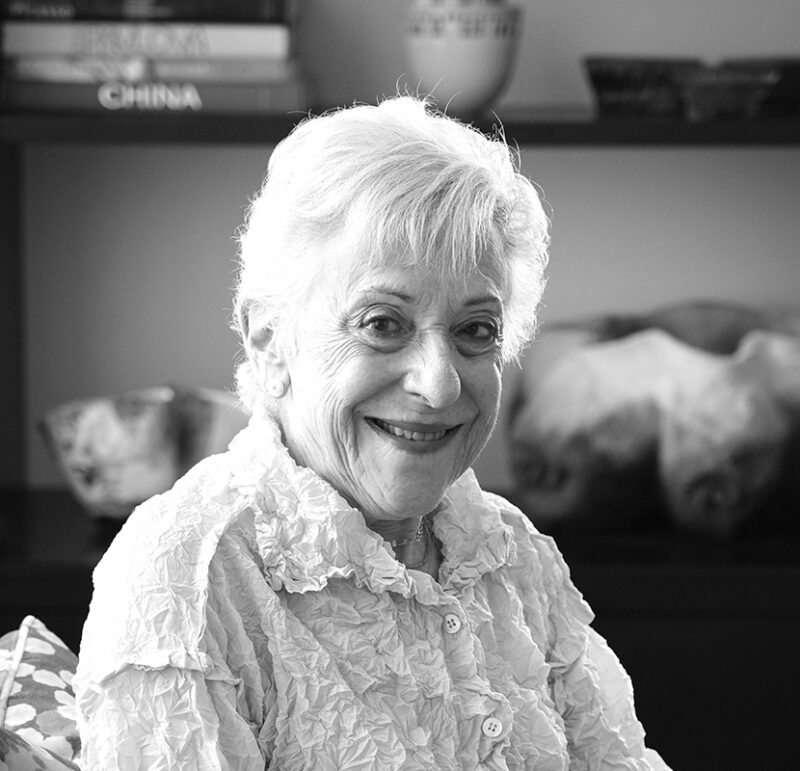
Charles and Lynn Schusterman Family Philanthropies has been at the forefront of Jewish giving for more than three decades. Sapir’s Ariella Saperstein interviewed founder Lynn Schusterman and her daughter, Stacy, who now chairs their giving, about how they balance their commitment to Jewish as well as secular causes at a time when both feel increasingly urgent.
Ariella Saperstein: Lynn, you set up your foundation nearly 40 years ago. What were your primary concerns and motivations at that time? Were you thinking about legacy?
Lynn Schusterman: My late husband, Charlie, and I were both raised in homes in which giving back was a core value. I can still hear my father reminding me, “Each of us is worth only what we are willing to give to others.” This was a value Charlie and I shared, so much so that our second date was at an event to raise money for the United Jewish Appeal.
When we started our foundation in 1987, Charlie had been diagnosed with chronic myelogenous leukemia. We knew his time would be limited, and we wanted to give together while he was still alive — not just in his memory. From the start, our giving was rooted in our Jewish values of tzedek (pursuing justice), tikkun olam (repairing the world), and derekh eretz (treating all people with dignity and respect).
We wanted to leave a legacy of real impact. We drew our inspiration from the Talmudic story of Honi the Circlemaker, who said, “Just as my parents planted for me, so I will plant for my children.” Our guiding philosophy has always been to work today so that our children and grandchildren might inherit a better world.
In many ways, our concerns and motivations were no different than they are today: to assure a strong, vibrant future for the Jewish people, for Israel, and for our hometown of Tulsa, Oklahoma. Some of our first investments — helping to establish the American Israel Education Foundation (the educational arm of AIPAC), supporting Hillels around the world, addressing child abuse through the Parent-Child Center in Tulsa — remain our grantees today.
We knew that giving effectively would require us to bring the same focus, due diligence, and risk-taking to our philanthropy that Charlie brought to the energy business. For the first decade or so, we experimented. We made various kinds of grants, both small and large, strengthening existing organizations and establishing new ones. We pursued excellence every step of the way by striving to be the best possible partner to our grantees and focusing on areas where we believed we could make an impact.
Ariella: How did you think about balancing giving to Jewish as well as non-Jewish causes? Has your thinking evolved since then as other generations have become involved?
Lynn: In the early days, we relied on a 75/25 rule, directing 75 percent of our giving to Jewish and Israeli causes and 25 percent to secular efforts to improve the quality of life in Oklahoma. The framework helped us focus and prioritize among many important needs and interests. When Stacy got involved with the foundation, we expanded the public-education work we had started in Tulsa into our first national secular grants portfolio. That was the first of several new secular portfolios, which now include criminal-justice reform, democracy and voting rights, and gender and reproductive equity.
Stacy Schusterman: When I became chairwoman in 2018, we wanted to be part of a broader effort to address barriers in the United States that prevent individuals and communities from realizing their true potential. I see a quality education, economic and reproductive freedom, government representation, and ending mass incarceration as key to addressing those barriers and to creating pathways to better jobs, a strong economy, and a healthy democracy.
The 75/25 rule no longer holds, but we remain committed to our “both/and” approach. We don’t see our giving as a zero-sum game. Rather than making tradeoffs, we expanded our philanthropy overall, doing more Jewish and Israeli giving, and more secular giving as well.
Everything we do, though, stems from our Jewish values. We feel a responsibility to show up as Jews to do what we can to benefit all people. This matters for Jews, too — the healthier our societies, the more Jews will thrive. This is the beauty of Jewish philanthropy: To give Jewishly is to give with our own people and also with other communities in mind.
Lynn: These values are so deeply ingrained in our family. Growing up, I watched both of my parents consistently go out of their way for others. One of my fondest memories is of holding my father’s hand as he visited elderly people who had no one else to care for them. This was compassion in action, a duty imparted by Jewish tradition to treat all people with dignity.
These responsibilities are a profound gift that Judaism gives us. So much of our work is to enable every young Jew to discover and relish in the joy of Jewish life and the sacred task we all share to care for the most vulnerable, to heal what is broken.
Ariella: Some argue that more of Jewish philanthropy should be going directly to Jewish causes because no one else will fund them, while many others will fund education or the arts. What is your response to such arguments?
Stacy: We believe in doing both. We’re fortunate to be able to give in both the Jewish and secular arenas and will continue to do so. The tension we hold between our universal and particular callings is a feature of Jewish peoplehood, not a bug. The roles we must play for our own people and for the world around us are interwoven. To separate one of the strands would be to unravel something sacred. It’s why we invest in strengthening the Jewish people and Israel, as well as building societies that are more just and inclusive. Both are part of our calling as Jews. Indeed, Rabbi Hillel’s thought would not be complete without both questions: “If I am not for myself, who is for me? If I am only for myself, what am I?”
Ariella: You’ve been involved philanthropically with many different areas — including some that have appeared to be in conflict after October 7. Lamentably, so much of the social justice sector has adopted an anti-Zionist worldview, and the ideological underpinnings of much of that work in America today puts it into direct conflict with Zionism. How have you responded to the anti-Zionism and antisemitism of the sectors in which you are so heavily invested?
Stacy: It has been extremely painful to see how deeply entrenched antisemitism and anti-Zionism have become in vital sectors of American society. We knew it was there, but October 7 and its aftermath have been eye-opening in terms of how deep it runs.
We believe that Jews have a rightful seat at the table serving justice causes. Since October 7, we have focused on being as clear as possible with our grantees about who we are and what we stand for, as reflected in our philanthropic mission. This has meant being clear with our secular partners about our Jewish and Israel work, and being clear with our Jewish and Israel partners about our secular work.
We strive to stay in relationship with our grantees and to foster open, respectful conversation when tensions do arise. In many cases, these conversations lead to deeper understanding. While we don’t expect our grantees to hold the same perspectives as we do on every issue, we also don’t support any organization in any area of our grantmaking that is actively working in opposition to our mission.
Ariella: How do you respond to critics who say that a small number of wealthy Jewish foundations — yours included — hold outsize influence over the priorities of the Jewish communal agenda? What’s your philosophy about wielding power through philanthropy?
Lynn: I always say that while we, as funders, help make it possible, our grantees make it happen. We are successful as funders if our grantees are successful, but we are not on the front lines the way they are. Our role is to provide resources and support for our grantees as they lead the charge toward our shared goals. We are partners.
Power dynamics are inherent in many interactions between funders and grantees, but our approach is to trust our grantees to be the experts in their fields, and to give them as much flexibility and runway to do their work as possible. So, for example, we prioritize multiyear general operating support, which enables organizations to think long-term and use our capital in the most effective and strategic ways possible. We also seek to learn from others in the field — including funders and policymakers — and to find areas where we can work collaboratively toward shared goals.
The bottom line is that all funders invest according to their mission and values. Our aim is to be a reliable and trustworthy partner, to be responsive to the expressed needs of the organizations and fields we support, and ultimately, to make a positive case for our work in a way that inspires other funders of all sizes to join us and do the same.
Ariella: How ought we balance the desire to keep the Jewish community diverse in terms of political and religious opinions with the realism that we also need to hold together as a community?
Stacy: “How big is our tent?” is a question as old as our people. The Jewish people are incredibly diverse, and we believe that the more inclusive we can be, the better. We work actively to create space for people who are open to learning from people who are different from themselves, who want to wrestle together with the big issues of our time.
Our focus has been less on defining who is in or out of the tent than on ways to engage the broad swathe of Jews who are able to hold nuanced perspectives and who are open-minded, curious, and willing to learn. We think this has the dual benefit of helping more people feel part of the Jewish community while moving past the extremes on both sides. We like the advice scholar Mijal Bitton shared at Hillel International’s centennial celebration: We need to have very clear principles and values while also being radically welcoming.
Ariella: Have you ever regretted a philanthropic decision? What did you learn? What has influenced your decisions to halt certain philanthropic initiatives?
Stacy: As funders, we have an obligation to continually assess whether our work is truly serving the goals we’ve set out to advance. That means being willing to evolve along with the fields we support and, at times, making the difficult choice to step back from initiatives we care about deeply.
In 2024, we chose to move away from operating our own U.S.-based programs, including our REALITY Israel travel program and our Schusterman Fellowship program. We recently made the same decision in Israel and will sunset ROI Community in 2026. These programs were hugely impactful from our perspective and essential for supporting efforts to expand Israel travel, leadership development, and Jewish engagement.
But after 20 years of operating programs, we determined that the fields we support through our Jewish and Israel grantmaking had evolved to a place where we could best serve our shared goals through funding, not operating. It was hard to let go of initiatives we valued, but we felt strongly that this shift was in the long-term best interest of the work.
Ariella: What is one overlooked opportunity or “moonshot” idea you wish more Jewish philanthropists would fund?
Stacy: One overlooked opportunity is investing in the field of Israel studies on U.S. college campuses. Countries such as Qatar are investing enormous sums in U.S. higher education to inform how future generations think and lead. The Jewish community can do much more to strategically and dramatically expand academic programs in Israel studies. Strengthening Israel studies is essential if we want to ensure that tomorrow’s leaders encounter rigorous scholarship, nuanced perspectives, and opportunities for meaningful engagement with Israel and the broader Middle East region. While we may not be able to invest at the same level as state actors, we can do the work to understand and double down on what’s effective in the academic arena. This is a critical investment in shaping the thinking of future policymakers and decision-makers, as well as healthy discourse, for the medium and long term.
Ariella: What would you advise new Jewish funders looking to expand their philanthropy while also focusing it?
Lynn and Stacy: Two recommendations come to mind: Give strategically with intention, and don’t do it alone.
Participating in funding collaboratives and other shared-giving ventures is one of the most effective ways to learn about different philanthropic approaches. You get to see up close what works and to team up with a built-in set of peers who can think with you as you expand your grantmaking. We’ve done this through initiatives such as Blue Meridian Partners and the Jewish Community Relief and Impact Fund, both learning from and sharing with our partners.
We also cannot stress enough how important it is to take the time to reflect on your values and the causes that matter most to you. Think about your passions. Determine your comparative advantage as a funder — maybe it’s your style of giving, your willingness to take risks, your commitment to tradition, or your willingness to fund the nuts and bolts of the sector. Identify the area and philosophy that will guide your giving, and from there, lay out a strategy, identify a few anchor grantees you can really get behind, and commit to the vision. Most important: Just get going. Give, and give generously. We have no time to lose.
We believe that the entire field of Jewish philanthropy benefits when funders approach their work with humility — we don’t have all the answers; with optimism — change starts with believing in what’s possible; and with a spirit of collaboration — we are in this together, striving toward a more just, inclusive, vibrant and peaceful future for all.