
A SAPIR idea comes to life
Sapir was founded to bring ideas to life. Check out eJewish Philanthropy’s coverage of how a 2023 article by our editor-in-chief Bret Stephens inspired a new center in Atlanta.
A SAPIR essay imagined ‘Jewish thriving.’ Atlanta’s Dupree built it a home.
New center for adult Jewish education aims to serve as a hub for the Southeastern Jewish community
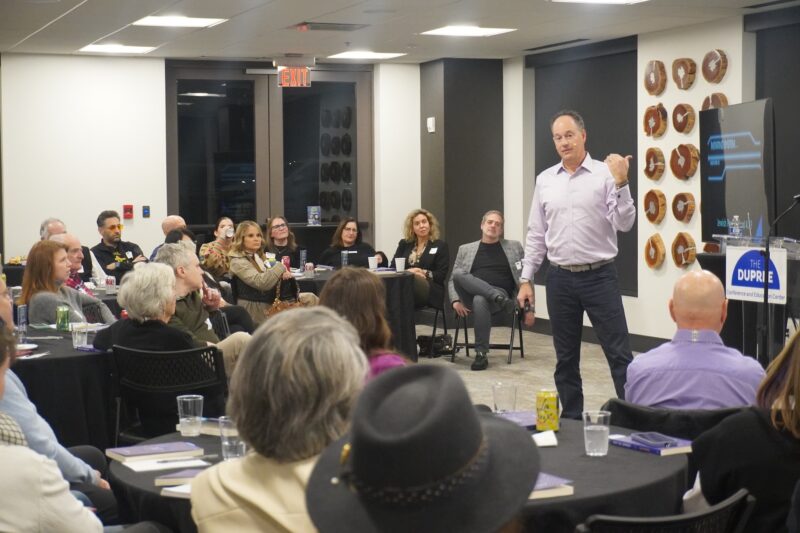
Zack Bodner, founder of the Z3 Project, speaks at the Dupree Center in Atlanta.
By Justin Hayet
August 6, 2026
Walk into Atlanta’s Dupree Center and, as community leader Michelle Simon puts it, “It’s like ‘Cheers’; everyone knows your name.”
In his 2023 Sapir essay “Three Falsehoods About Antisemitism—and One Truth,” Bret Stephens drew a distinction between “thriving Jews” who succeed as individuals and the collective flourishing that he referred to as “Jewish thriving.” At Atlanta’s new Jewish education hub, The Dupree — as the locals call it — that idea is coming to life.
The early evidence is in the turnout. Dupree’s board braced for a slow start, but the community responded in full force, drawing 4,347 community members to 120 programs so far this year, the center told eJewishPhilanthropy. Months into her new role, founding executive director Dana Sender-Mulla frames the stakes plainly, making the case that deep adult education is how Jewish identity gets built and passed on. “Jewish identity won’t carry itself forward on inertia alone. It has to be chosen, cultivated and built — in real places, by real communities,” she said.
The idea for Dupree originated with Atlanta-based philanthropists Helen and David Zalik as part of their long-term strategy of investing in Jewish education. Sender-Mulla said that while it did not entirely originate from Stephens’ 2023 essay, The Dupree framework was molded as he defined Jewish thriving, as a collective ideal: a secure and self-confident Israel; a proud and knowledgeable Diaspora; and Jewishness held as the most cherished part of a person’s identity.
“Jewish education has always been close to my heart, because Jewish wisdom is where so many of us find meaning and purpose in our lives,” said Helen Zalik in a statement to eJP. “Adult Jewish education is at the heart of The Dupree: a place to keep growing into who we are as Jews, no matter where we start.”
The Dupree is also a physical hub. The building houses nearly 20 Jewish organizations, with three more in the works, among them the Jewish Federation of Greater Atlanta and Hillels of Georgia, alongside commercial tenants and a kosher restaurant. For security reasons, the center does not publish a full tenant roster, leaving each organization to decide how and when to discuss its move.
“We weren’t interested in creating an office building for Jewish organizations,” Sender-Mulla said. “We wanted to create a place where the Jewish community naturally comes together every day — a home for organizations, learning, culture, philanthropy and conversation.”
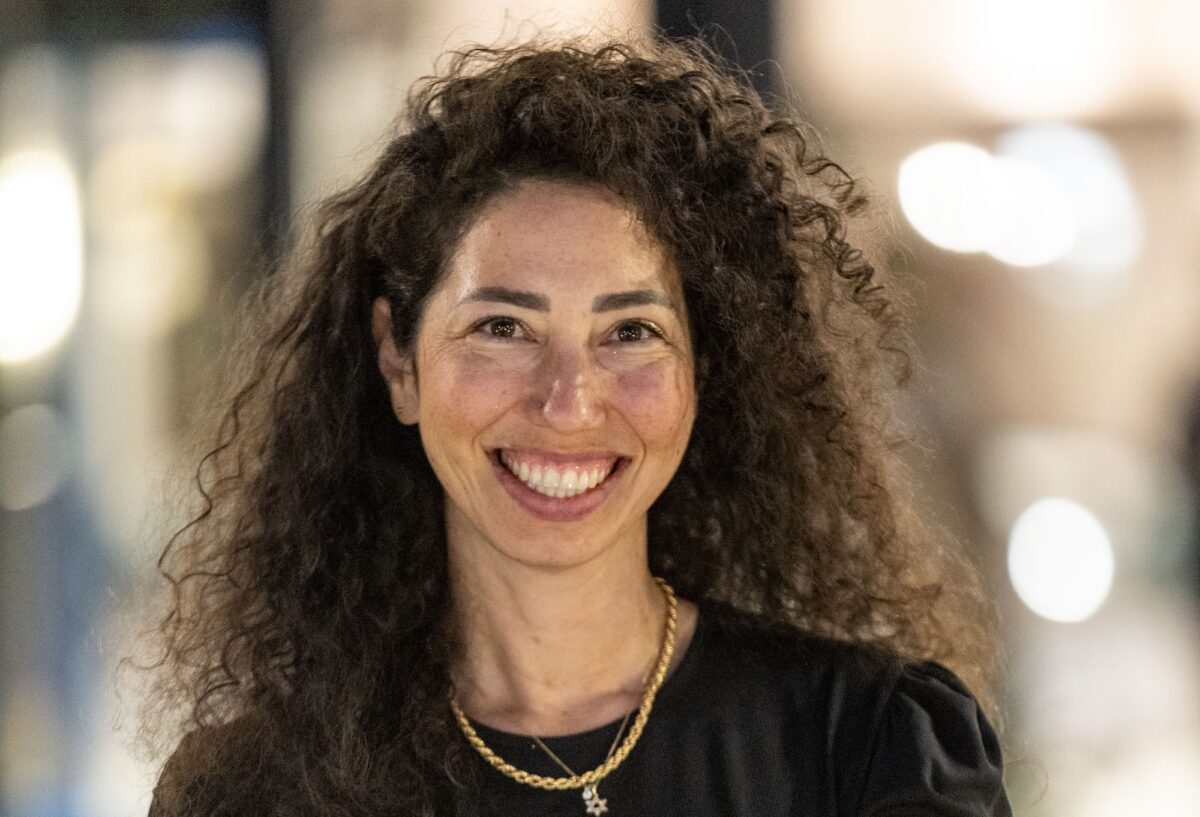
“When organizations share the same space, chance encounters become collaborations,” she said, “and people begin thinking of themselves as part of a larger community rather than separate institutions.”
Sender-Mulla was equally clear that the center sits alongside Atlanta’s established institutions. “We don’t see ourselves as competition with other [Atlanta-based] organizations, but rather as an opportunity to uplift things that are already happening in the community,” she said.
Sender-Mulla recently joined the organization, relocating from South Florida with her husband, their four children and the family dog, Shalom. Raised in Israel, Sender-Mulla found her passion for the field in the Diaspora. “I found the love for this field when I was a teenager living in Singapore and understanding what it was to be a Jew in a setting as a minority,” she said.
The work has always been personal. “I had a lot of knowledge and connection to my Israeli identity and very little to my Jewish one,” she said, describing the gap that shaped her career. That arc informs a conviction she now applies at The Dupree: adult education carries the highest strategic return. Invest deeply in a parent, she said, and the effect reaches children and grandchildren.
Sender-Mulla drew a straight line back to Stephens, whose 92nd Street Y address this year also sent ripples through the Jewish community. He warned that building Jewish identity around combating antisemitism hands the antisemite the first and last word on what it means to be a Jew.
The center calls itself a Zionist organization and welcomes Jews across the spectrum, Sender-Mulla said. It will not partner with groups that deny Israel’s right to exist.
The center has hosted former Israeli Ambassador to the United States Ron Dermer; journalist Yossi Klein Halevi; Andrés Spokoiny, president and CEO of the Jewish Funders Network; Rabbi Elie Kaunfer of the Hadar Institute; and Zack Bodner, founder of the Z3 Project, among others. Natan Sharansky and Rabbi Meir Soloveichik are among those slated to come.
Atlanta is the 11th-largest Jewish community in the United States. Sender-Mulla paired that scale with a Southern intimacy in which newcomers get woven in quickly — a growth community fueled by transplants who often arrive without extended family or a childhood synagogue nearby, she said, so places that create belonging matter more.
Michelle Simon, the local Jewish federation’s women’s philanthropy president, has become a regular at the center’s programming. She has attended lunch-and-learns and heard speakers there, drawn by a calendar she describes as consistently substantive. “It’s the hub of our Jewish community,” she said.
Simon said she values the center most for the range of learning it makes possible on any given day. “There’s always something for everyone, and for everyone to feel they have a place there,” she said.